We are delighted to provide four concerts for our 52nd season, 2025-26:
Sunday October 26, 2025 - From Salzburg to Paris
Sunday December 14, 2025 - Young Soloists Concert
Sunday March 1, 2026 - Romantic Echoes
Sunday May 3, 2026 - From Triumph to Tragedy
For information on purchasing tickets, click here
Concert Venue
All the concerts will be held at Dundas Street Centre United Church at 482 Dundas Street in London.
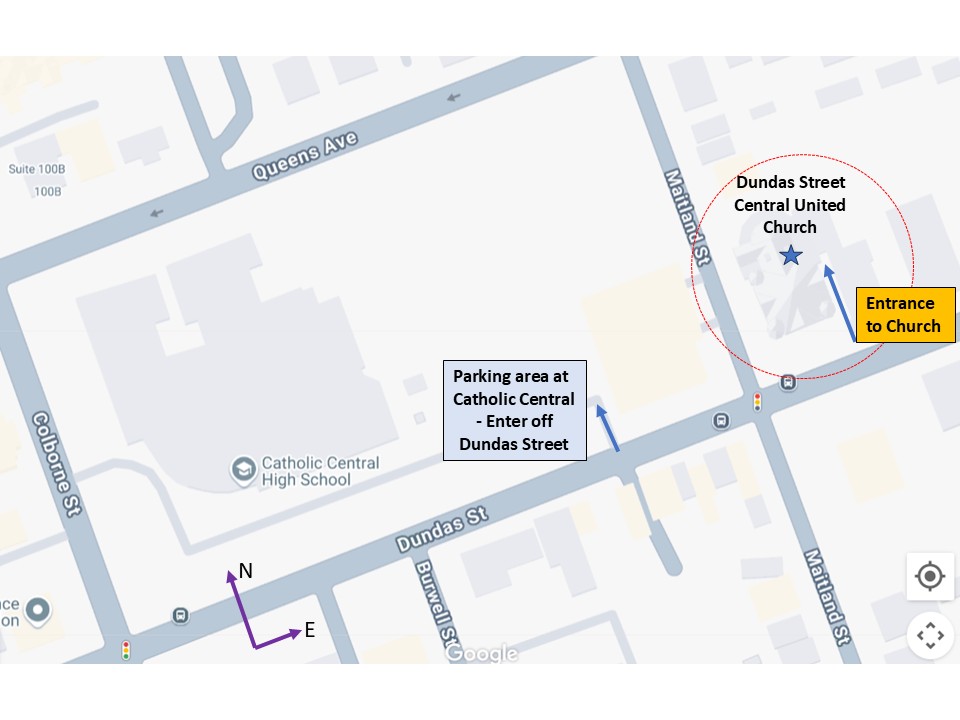
The church is located at the northeast corner of the intersection for Dundas Street and Maitland Street (see map below). The entrance to the church is off Dundas Street.
Accessibility of the Concert Venue
The pathway leading from the sidewalk to the church door is accessible for people using mobility devices, such as walkers and wheelchairs, as there are no stairs to enter the church.
The concert takes place in the sanctuary of the church – the audience has seating in the pews. Seating for the concert can be had on two levels – the main level you come into the church and the balcony, accessed by a set of stairs at the end of the foyer on the main level. There is no elevator within the church to access other floors from the main level.
The women's washroom is located on the main level of the church close to the entrance of the church. The men’s washroom is in the basement, accessed by a flight of stairs.
Parking
Parking is available at Catholic Central High School (the entrance to the parking lot is off Dundas Street west of Maitland Street) or on the streets around the church. (See the map above for location of the parking)
Important information: Please note, we do not have an arrangement for people to park in the lot directly to the east of the church and you may be ticketed if you park there.
Is this your first concert?
If you are coming to one of our concerts for the first time, we hope the information below will answer any questions you may have so that your experience is welcoming and enjoyable as a new audience member.
What is a community orchestra?
Our orchestra members are primarily amateur musicians from London and the surrounding communities. We come from all walks of life and ages. We have come together to share our passion for music and play for enjoyment and community engagement.
What is a symphony orchestra?
A symphony orchestra is a large group of musicians who play different instruments. The instruments in the orchestra fall within 4 basic categories: strings (violins, violas, cellos and double bass), woodwinds (flutes, oboes, clarinets and bassoons), brass (trumpets, tubas, trombones, and French horns), and percussion (timpani, drums, and occasionally piano). The London Community Orchestra has a core membership of 40 people and that number can increase depending on the different musical pieces that we play.
Will I recognize the music?
You will probably recognize some of the music we perform. Classical musical is often used in movie soundtracks, commercials or in retail shops and elevators as background sound. This is also a good opportunity to try something new and see if you like the music.
Additionally, our programs regularly include works from lesser-known composers and lesser-known works from more recognizable names in classical music. These pieces may not be recognized by a large segment of the people who attend our concerts, so don’t feel you have to do research on the music before coming to the concert. Programming lesser-known works can introduce our wider audience to a broader range of musical styles, time periods, and composers than they might otherwise encounter.
Can I bring children?
We welcome parents and their extended family to bring children to our concerts. It is important to note, the audience is expected to sit quietly for extended durations during the concert and we are aware that young children may become restless. For young children we leave it at the discretion of parents whether to bring their children. If your child does become restless during the concert we ask you to take a break outside of the concert auditorium to minimize any disruption of the listening experience to the other audience members.
Perfume or cologne?
The church is a fragrance-free area and we hope people will refrain from wearing perfume or cologne.
Can I take photographs or videos?
No pictures, videos or audio recordings may be taken during a concert performance. All electronic devices (e.g., cell phones) need to be switched off or put on airplane mode to prevent disruptions during the performance.
What is the role of the Concertmaster?
The person sitting in the first chair position of the first violins is known as the Concertmaster. They play a leadership role within the full orchestra. In the concert performance, they are the last musician to take their seat on the stage and they signal the orchestra members to begin tuning at the beginning of the concert before the conductor arrives on stage. Currently, our Concertmaster is Carolyn Martinelli.
When should I clap?
If you are a new to a classical music concert, audience etiquette may seem a bit of a mystery for what to do and when. The information below should help to explain how audiences usually engage with showing their appreciation.
At the beginning of the concert, the concertmaster will be the last musician to come onstage and the audience applauds as a welcome and a sign of appreciation for all of the musicians. After the musicians have finished tuning, the conductor and possibly the soloist will enter, and will be welcomed with more applause.
As for what to do during the performance of the music, most people wait until an entire piece is over to clap. So, people don’t clap during the small breaks between movements or sections of a single piece. Your music program you receive when you arrive at the concert will list the movements within each piece so that you can follow along. The conductor will also signal that it is the end of a piece by lowering their arms and turning to face the audience.
If you’re still unsure when you clap, it’s a safe bet to follow along with what the rest of the audience is doing.
What should I wear?
There is no dress code for audience members. Choose what is most comfortable for you to wear. The musicians will be wearing all black as that allows the focus to be on the music and not the fashions of the individuals in the orchestra. Soloists may dress differently than the orchestra members – usually a more distinctive clothing that is still in a formal style.